
Again – American Banks
It has been a whirlwind start to the month of March 2023, where bank failures in the US sparked global investor panic.
Two banks, Silvergate and Silicon Valley Bank (SVB), reported losses due to bond sales required to service significant deposit withdrawals. Customers started to panic because of this, which led to a bank run with both banks subsequently declaring bankruptcy. To prevent another bankruptcy, the Federal Deposit Insurance Corporation (FDIC) took control of Signature Bank a few days later, when it became clear that a similar scenario was unfolding there.
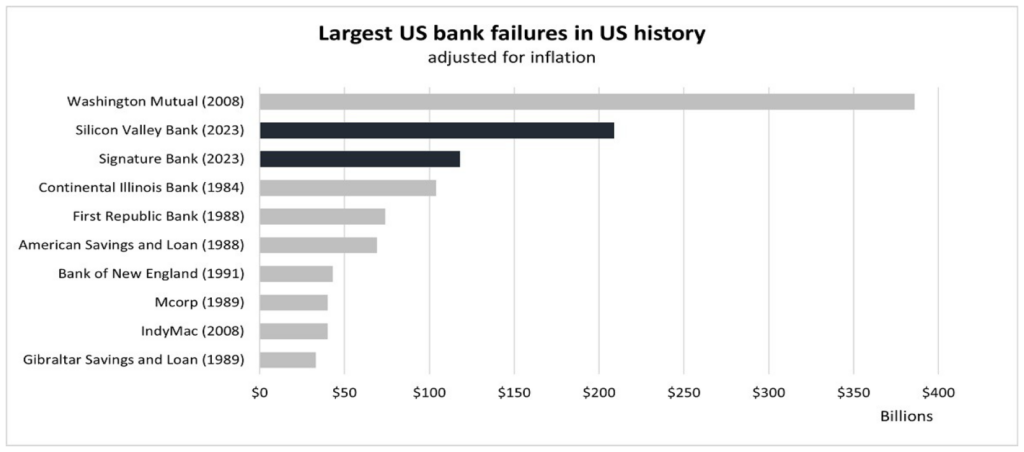
The failure of these banks raised concerns about a potential repetition of the subprime mortgage crisis of 2008, a worldwide financial disaster that lasted 18 months and cost the global economy $2 trillion.
The road to here
The past 15 years were known as a period of easy money with low interest rates and vast amounts of financial relief being injected into the global economy. This culminated in 2021 as reserve banks attempted to counter the effects of the Covid-19 pandemic sparing no expense. This abundance of capital led to startup companies attracting large sums of venture capital, while retail investors could afford to invest in risky assets.
Silvergate and Signature Bank were the partners of choice for crypto exchanges. Silvergate’s $11bn in assets were largely crypto-backed deposits, while 30% of Signature Bank’s $118bn asset pool were linked to crypto exchanges. The majority of SVB’s clients were venture-backed startup companies. SVB experienced significant growth over an 18-month period, where deposits grew from $62bn in March 2020 to $209bn by the end of 2022.
These banks derived a sizable portion of their revenue from the purchase of government bonds, as opposed to traditional banks who tend to rely on revenue from loans to customers. To mitigate the effect of low interest rates, Silvergate and SVB bought longer-term fixed rate bonds, which guaranteed a higher return. These bonds were still backed by the US government, so it seemed like a safe option.
These bonds did increase their interest rate risk should a rate-hike cycle occur. However, based on recent history, these hikes were relatively infrequent. They also believed that there was sufficient liquidity to service day-to-day withdrawals, so there would be no need to sell these bonds prior to maturity.
Then 2022 happened…
Amid soaring inflation in 2022, the US started to hike interest rates very aggressively. A shift to contractionary monetary policy ended the abundance of free money in the economy, causing investors to become more cautious. Startup funding rapidly decreased, and people started to lose confidence in cryptocurrencies.
As a result, people were withdrawing their crypto in droves, and startup businesses had to tap into their deposits to keep thing running. This led to sizable withdrawals from these banks over a relatively short period of time. Normally, this would not be a big issue for a bank with a diversified client base, but these banks had quite a homogenous clientele.
To service these elevated withdrawals, Silvergate and SVB were both forced to liquidate some of their longer-term bond positions. The problem is that interest rates and bonds have an inverse price relationship. With the massive interest rate hikes, these bonds had to be sold at a discount and both banks subsequently suffered investments losses which quickly became public knowledge.
Silvergate realized a $886 million loss on their bond portfolio which sparked a loss of confidence from their crypto exchange clients who started withdrawing their funds. A day later, SVB CEO Greg Becker addressed investors via Zoom, calling for calm. It was too late. Multiple venture capital funds had already advised their clients to move banks, causing
$42bn in withdrawals that day. SVB closed its doors the next day.
At the same time, on the back of Silvergate’s failure, crypto exchanges who banked with Signature Bank also left in a
panic. To avoid a third collapse, the FDIC took charge of Signature Bank.
All three of the bank failures happened in less than a week.
The inevitable fallout
The US government unveiled several emergency packages, including a new Federal Reserve lending facility for banks which assisted Signature Bank. Big banks in the US are reporting a large spike in flows as people move their money from smaller banks in what executives say is the biggest movement of deposits in more than a decade.
Stocks globally are reacting negatively, especially in the financial sectors. Trading was temporarily halted in dozens of banks after shares fell by up to 75%. The full impact is not yet clear, but the swift reaction from the US government appears to have stifled a further degradation of the US banking sector that could cause a domino effect across global markets.
Fortunately, this wasn’t a big fraud, unlike FTX last year where billions went missing. Deregulation in the US, stemming from legislation passed in 2018, lowered the capital and liquidity requirements for small and medium-sized banks. This allowed these banks to invest more deposits in long-term bonds instead of more liquid short-duration instruments.
While this wasn’t a sound investment strategy, these longer-term bonds can still be used to reimburse clients. Once the failed banks are liquidated, clients will be paid the money they are owed and the US government announced that any losses to clients will be fully reimbursed from an emergency fund that banks contribute to.
Events over the past few days have undoubtedly dented investor confidence, however it is clear that the US
government will do anything within its power to prevent a drawn-out crisis.
Keep calm and carry on
The past few weeks have yet again illustrated how quickly negative news can turn into a potential crisis when panic takes over. The initial losses suffered by these banks were concerning, but manageable. However, when the bank run started, they had no chance of survival.
The best defense against these events will always be a diversified portfolio that minimizes the impact of any single negative event while also sticking to your investment plan. Paarl African Group through Trèsor Wealth offers a wide range of well-diversified multi-managed solutions that aim to deliver strong risk-adjusted returns through market cycles.